










Blade Brilliance, the science of the perfect chef's knife
With the ease of a seasoned storyteller, Clément Colpé gestures toward his kitchen at Restaurant Panorama in Namur, Belgium. The space buzzes with controlled chaos as his team prepares for another busy service. ‘Sometimes we serve between 600 and 1000 covers a day,’ he says with a smile that suggests both pride and the weight of responsibility.
The history behind the blade
The chef’s knife seems so fundamental to the kitchen that you might think it has always existed in its current form. However, it has evolved gradually over centuries to become what it is today. New processing techniques and insights – and occasionally fierce competition – have elevated quality to unprecedented heights. The history of the chef’s knife tells a story of centuries-old craftsmanship, tradition, and international competition. From robust German models to elegant French designs and the masterful, refined craftsmanship from Japan.

Competition drives rapid progress, and the knife world exemplifies this perfectly. In 1910, the infamous ‘knife war’ erupted in Solingen, Germany, between two leading knife-making families. It wasn’t merely about patents or names, but about the honour of who forged the ultimate chef’s knife. The battle led to major innovations in steel processing, tempering, and ergonomics. Parallel to this, rivalry grew in France between traditional blacksmiths and industrial producers. Meanwhile, Japan quietly and steadily perfected its centuries-old craft – without engaging in the conflict. Perhaps that's why today they stand head and shoulders above their European competitors.
Global knife traditions
Over the years, each country developed its own distinctive knife style. While sharing some similarities, the knives from the major producing countries show substantial differences in design, weight, and functionality.
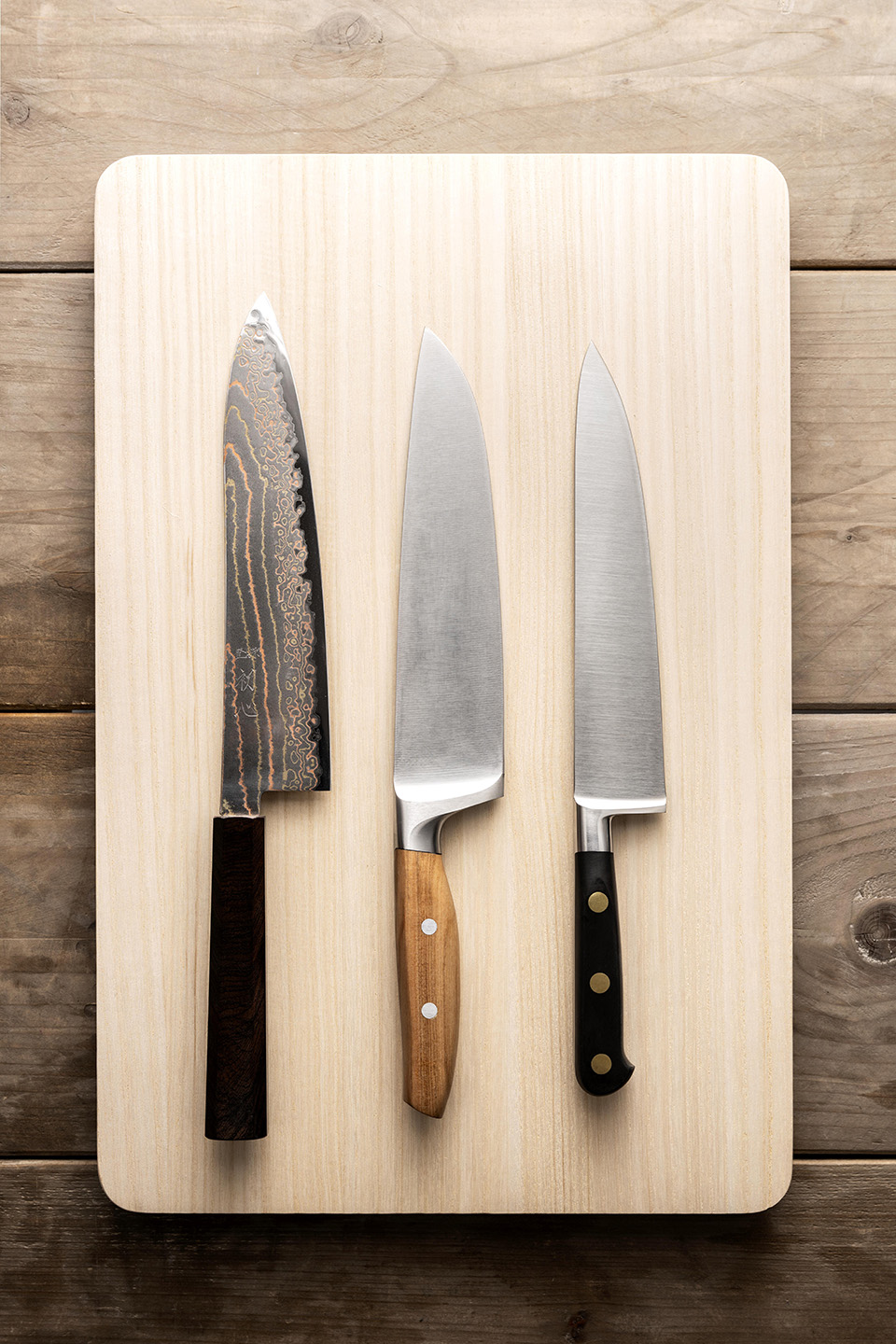
German chef's knives known from brands like Wüsthof and Zwilling, are built for durability. They are heavy, with a full tang (steel extending to the end of the handle) and a thick, slightly rounded edge – perfect for chopping hard ingredients.
French chef’s knives – such as those from good old Sabatier – are lighter, slimmer, and have a straighter edge, making them ideal for precise cutting techniques like julienne or chiffonade.
Japanese chef’s knives, often referred to as hocho or gyuto (the Japanese counterparts of the Western chef’s knife), are lighter, extremely sharp, and forged from hard steel such as VG-10 or traditional Shirogami (white steel). The hard steel allows Japanese knives to make paper-thin cuts, but they are also more prone to breaking.

You can buy chef’s knives almost anywhere these days – and at all price points. Online stores are countless, and even supermarkets offer them as part of loyalty programs. Yet, there are only a few true specialists: professionals who are passionate about the material and the craft. These experts travel the world seeking out the most exceptional blades, becoming trusted advisors to chefs who value quality. De Meesterslijpers exemplifies this specialist approach.
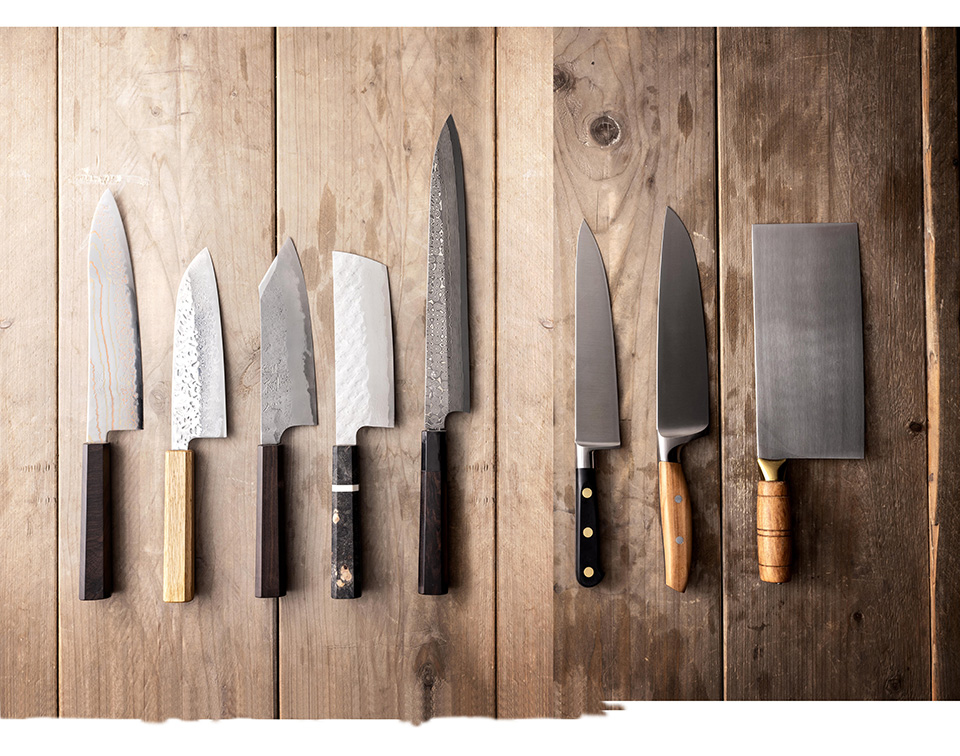
Japanese knives are renowned for their unparalleled sharpness and precision. They are often hand-forged according to centuries-old traditions and have a thinner edge than Western knives. Gyuto The Japanese counterpart to the European chef’s knife, versatile and suitable for almost all cutting tasks. Santoku Shorter and wider than the gyuto, ideal forvegetables, meat, and fish. Bunka Broadly the same as a santoku, but with a pointed tip. Very popular currently. Nakiri A rectangular vegetable knife, perfect for quick and precise cuts. Yanagiba A long, thin sashimi knife for slicing raw fish. Deba A heavy knife for filleting fish and chopping bones.
European knives are more robust and often have a thicker blade angle. They are versatile and suitable for heavy-duty work. French chef’s knife Long and slightly curved blade, ideal for rocking cutting techniques. German chef’s knife Heavier with a wider edge, perfect for powerful cutting and chopping. Chinese knives deviate from Western tradition and have their own style. Chinese chefs use their knives as a cleaver, chef's knife, and to pick up ingredients – making them truly multifunctional. Chinese cleaver Wide and rectangular, perfect for cutting, chopping, crushing, and picking up ingredients.
Expert tips for maintenance and sharpening
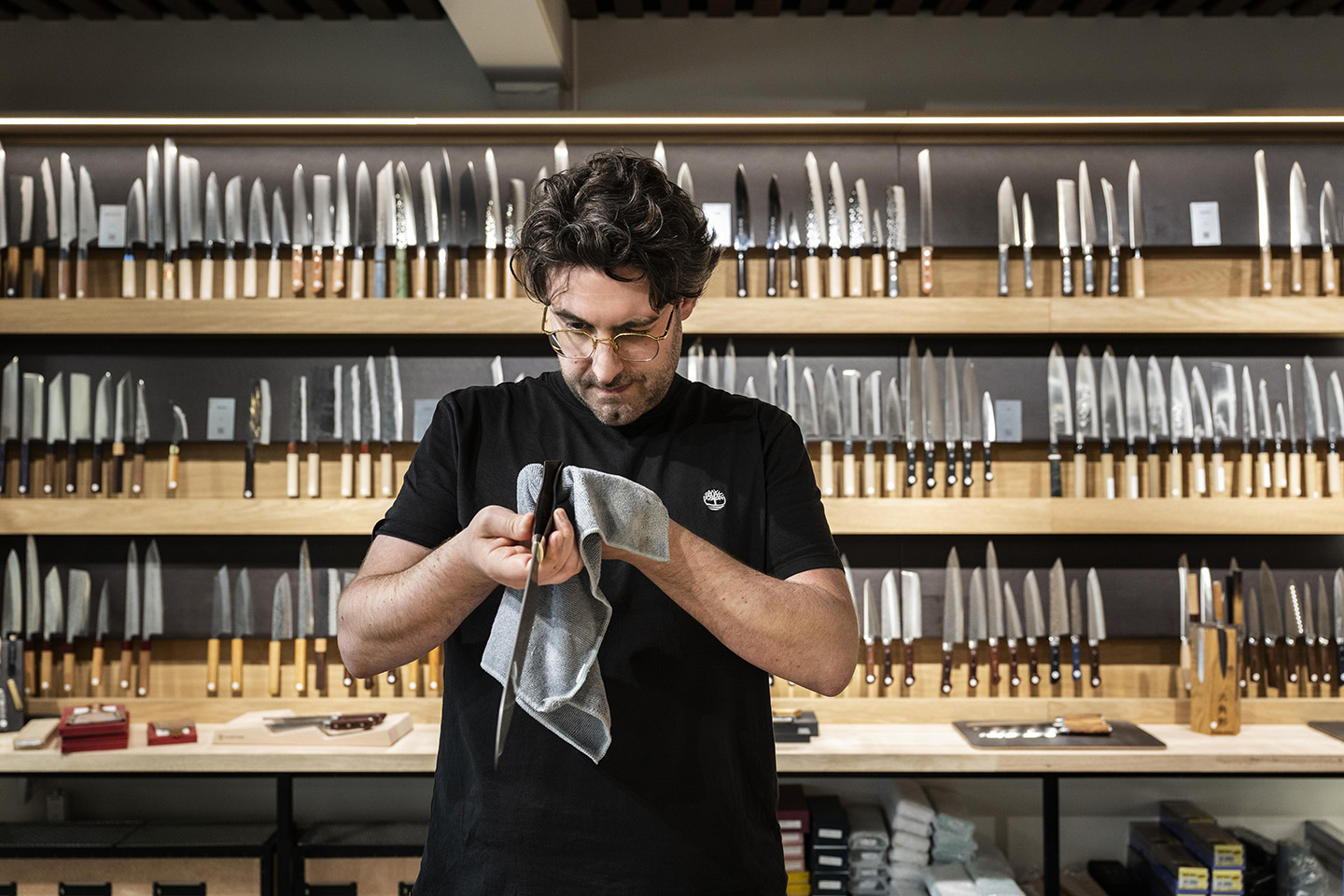
As we move from knife selection to maintenance, Berend's passion becomes even more evident. ‘People overcomplicate knife sharpening,’ he says with a dismissive wave of his hand. ‘Anyone can learn it with some practice.’ The knife specialist is part of a family operation – four expertly skilled individuals who each bring their own specialisation to De Meesterslijpers. ‘We’re actually three brothers and a brother-in-law,’ Berend explains with a smile, ‘but he feels like a fourth brother.’ While his colleagues focus on sales, customer relations, and business management, Berend has dedicated himself to the art of sharpening, accumulating years of hands-on experience.
Mastering the basics
Looking at the wide array of sharpening stones, honing rods, and leather strops on display, it's easy to feel intimidated. According to Berend, this is precisely the problem. ‘I see customers who’ve ruined perfectly good knives with improper techniques or the wrong materials,’ he demonstrates, running his finger carefully along a damaged blade. ‘But it doesn’t have to be that way.’ Leaning forward, as if sharing a trade secret, he continues: ‘The precise angle is particularly challenging, I won’t deny that. But consistency is more important than perfect accuracy. Once you understand the basics and practise a few times, you can maintain your knives quite well yourself.’ His confidence is reassuring – perhaps this isn't rocket science after all.
Proper knife care
The way you maintain your knives when not in use is just as important as proper sharpening technique. For optimal longevity and performance, follow these essential care practices: Hand wash only Never place your quality knives in the dishwasher. Harsh detergents and mechanical washing damage both blade and handle. Dry immediately Don't leave your knife to air dry. Thoroughly dry the entire knife, especially where the blade meets the handle, to prevent rust formation and corrosion. Store properly Keep your knife in a dedicated knife block, on a magnetic strip, or with blade guards. This protects the edge and prevents accidents.
Step-by-step sharpening guide
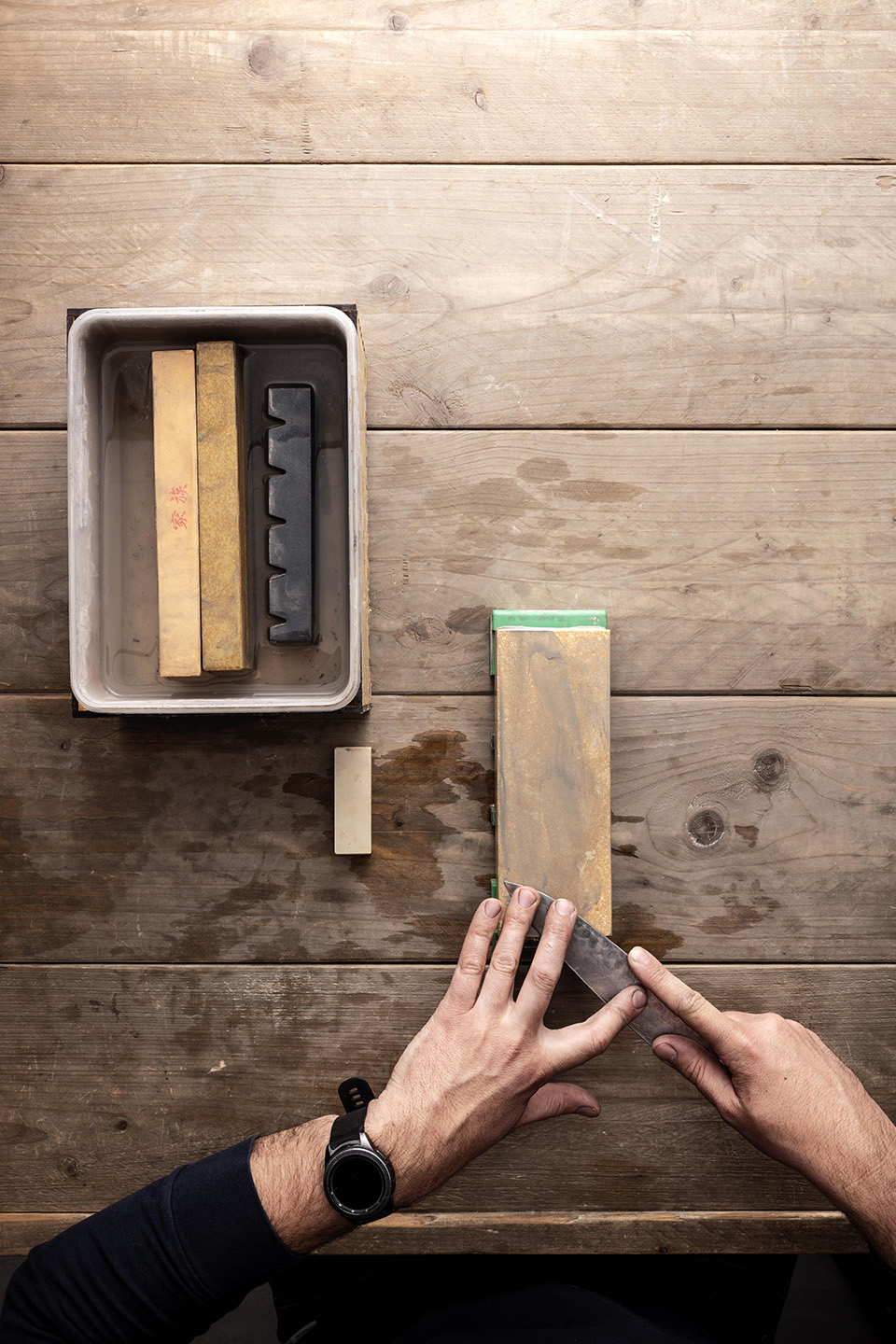
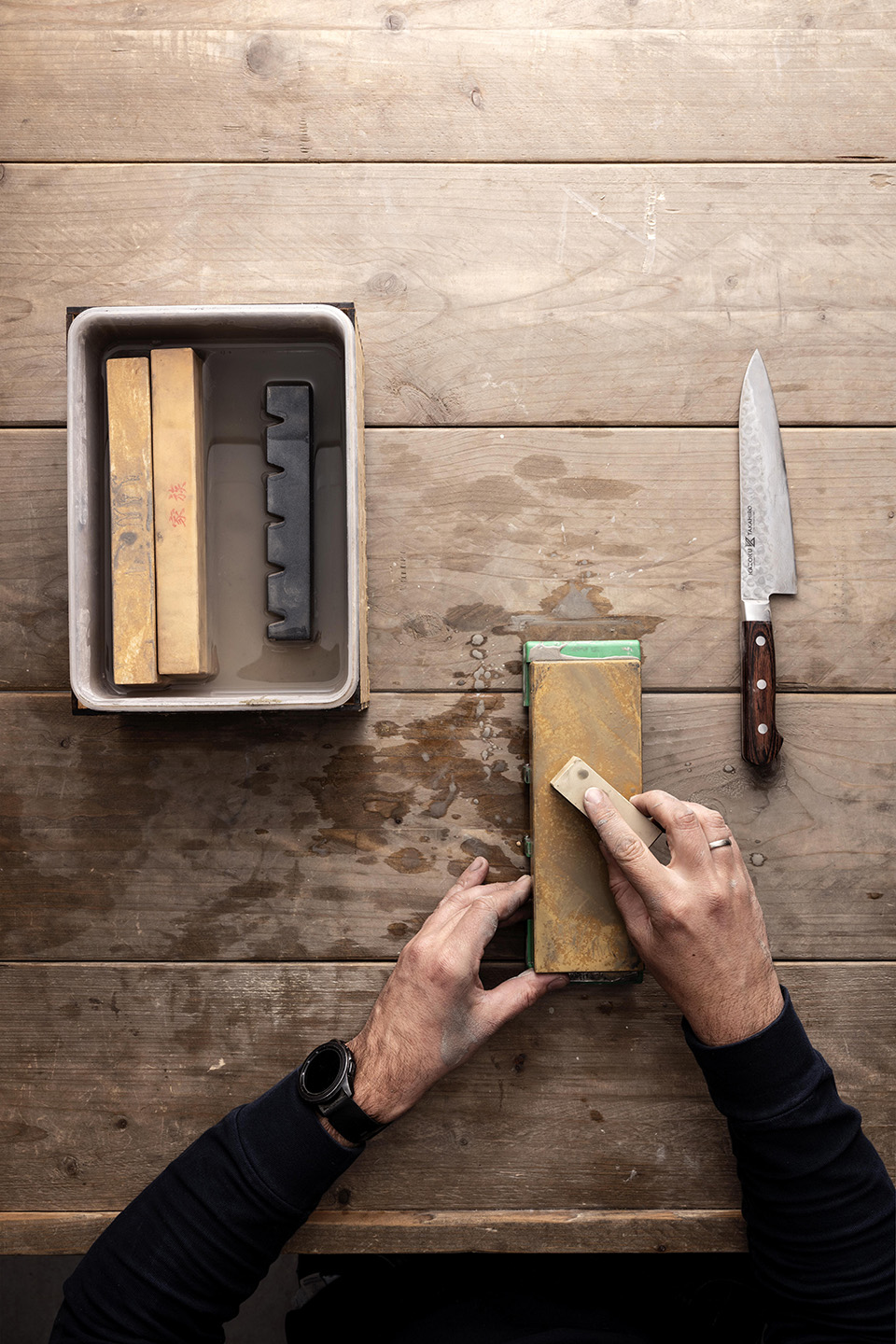
Step 1 It starts with the type of stone. Begin on a coarse stone (Grid 400) and ensure that stone is also maintained. You do this by keeping the stone flat with a flattening stone. Always soak the stone briefly in clean, cold water and
keep it wet.
Step 2 Place your index finger on the back of the knife and your thumb on the blade. Determine the angle and maintain it consistently. Start with the tip and move upward while applying reasonable pressure to the knife.
Step 3 Finish at the wide part of the knife. Then move (still maintaining the same angle) back down and end at the tip again.
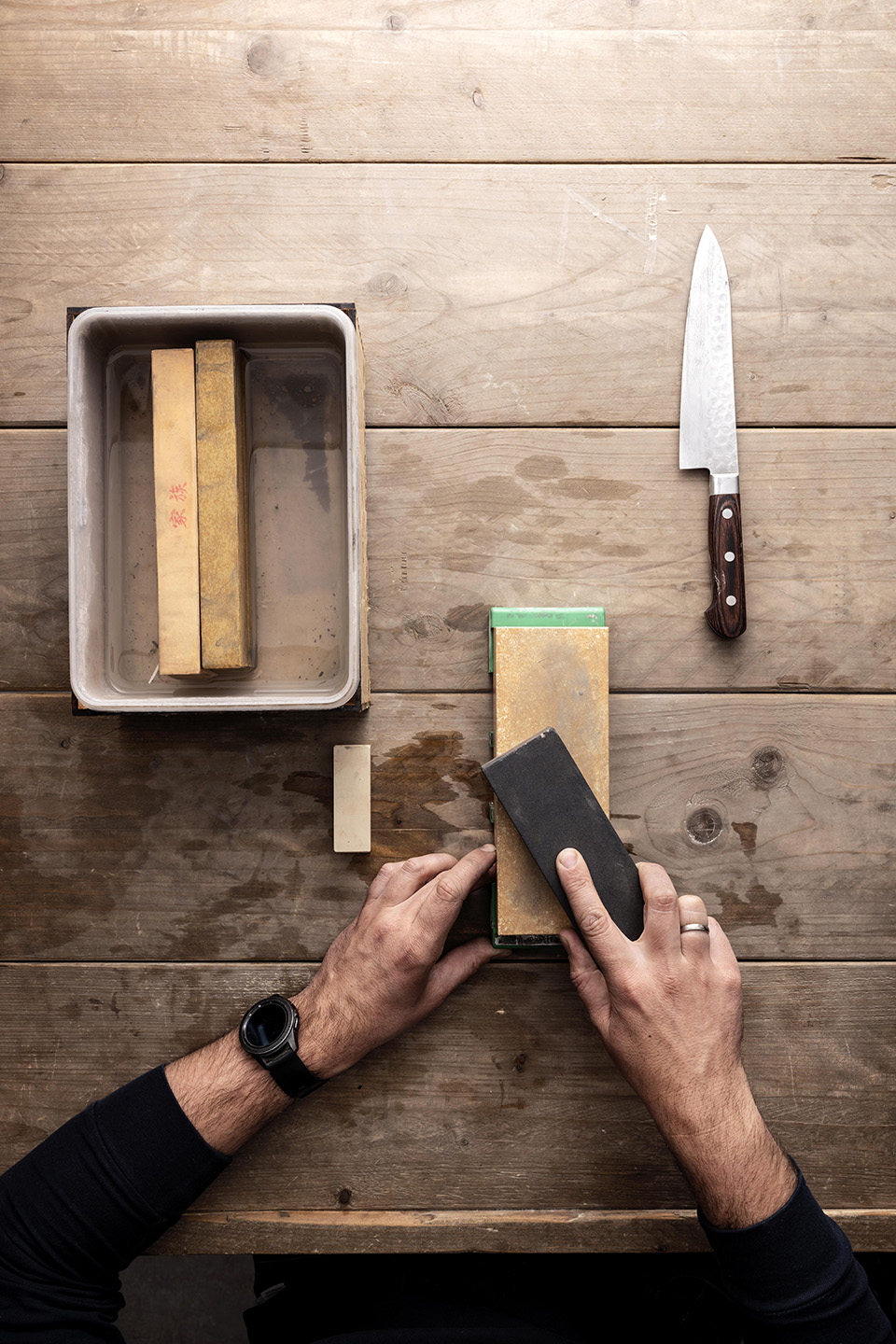
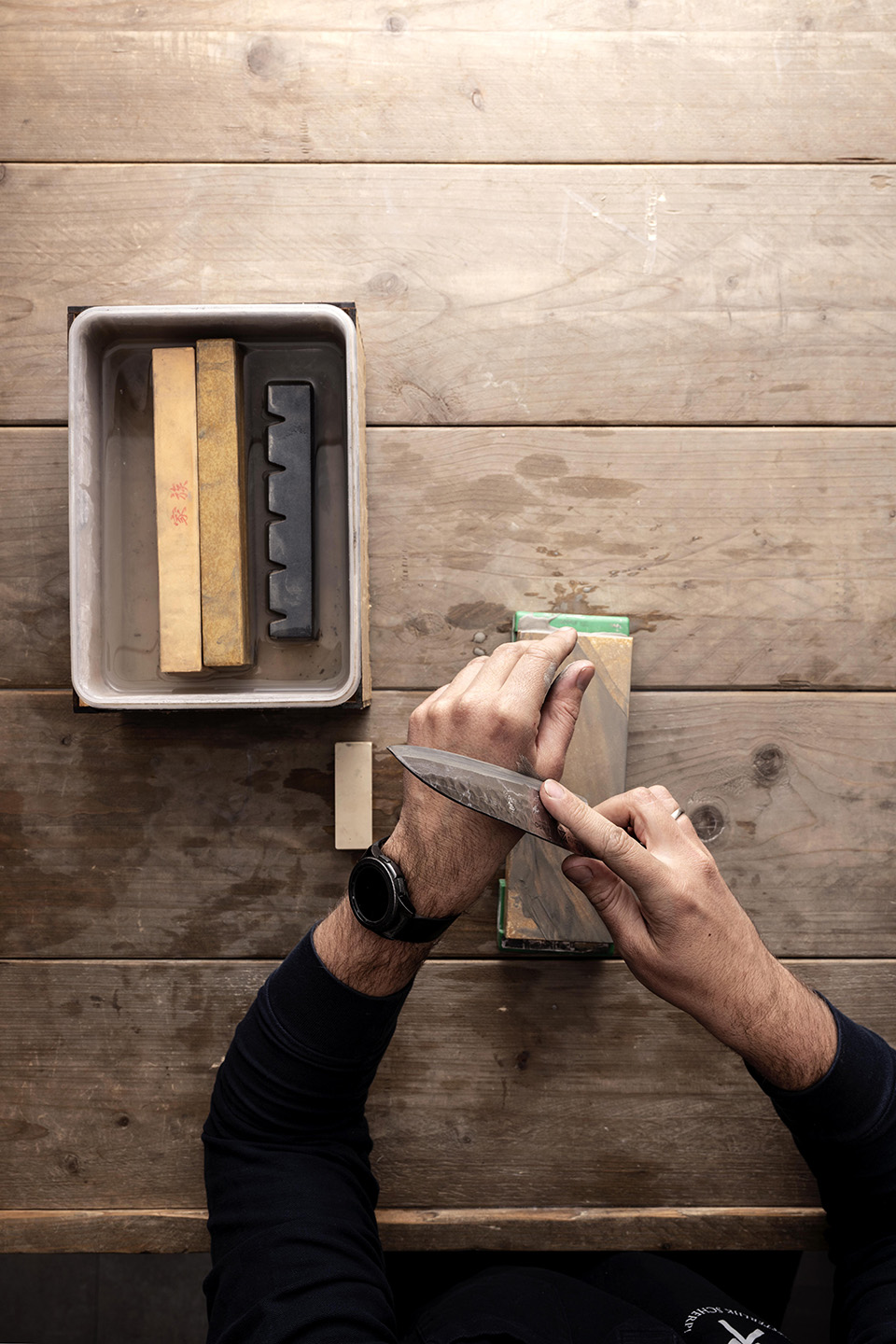
Step 4 Continue this up and down motion until you feel a 'burr'. This means the
cutting edge of the knife, the razor-thin part, leans to one side. Time to turn the knife over.
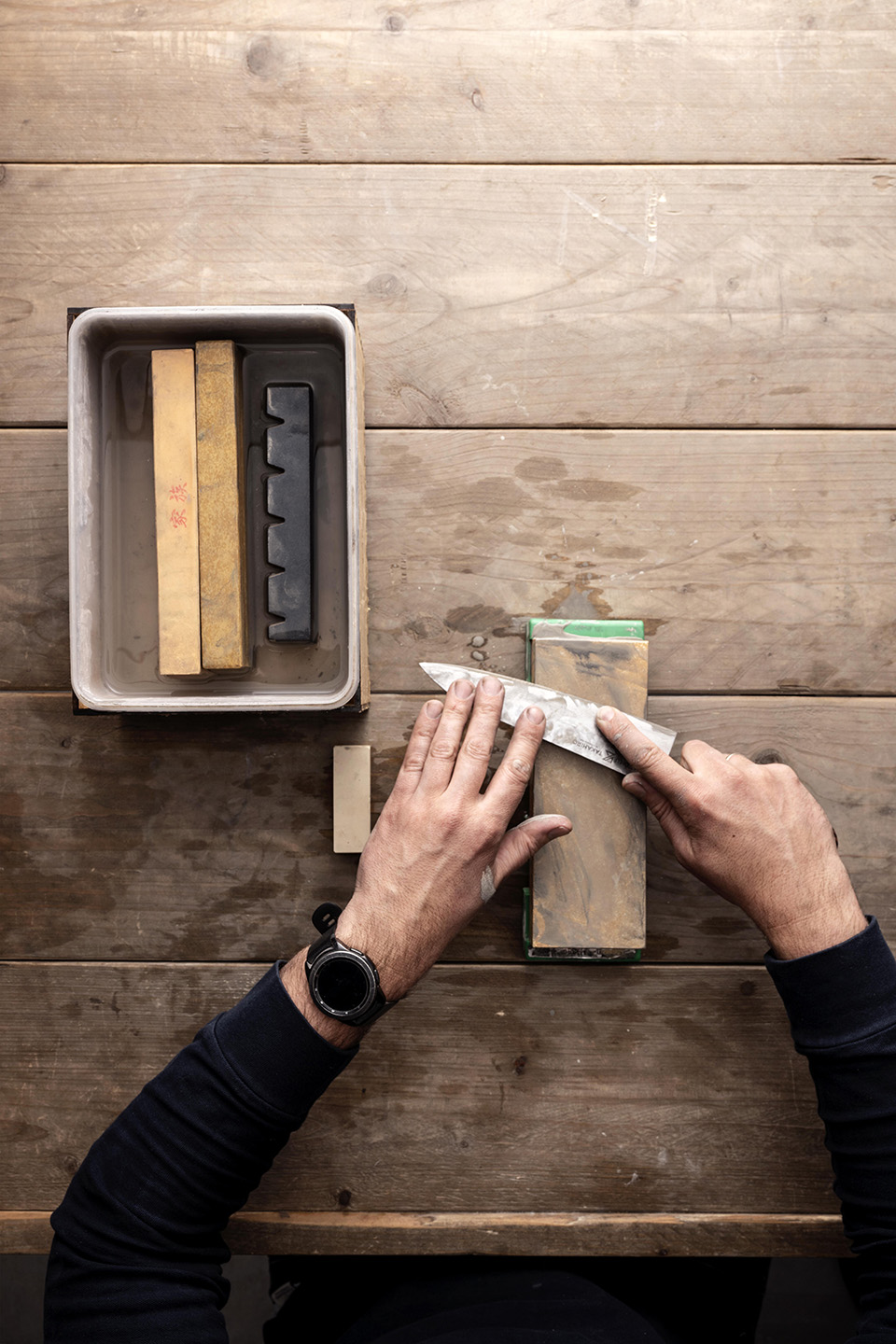
Step 5 Now do the same but in reverse. Place your thumb on the back and your index finger on the blade. Start at the top at the wide part of the knife and move downward. End at the tip. Repeat the movement until another ‘burr’ forms.
Step 6 The knife is already sharp, but you can polish it with a finer stone (grid 1000-1200). Then use a slurry stone to generate slurry, which is a kind of polishing paste that forms on the stone for an even smoother polish.
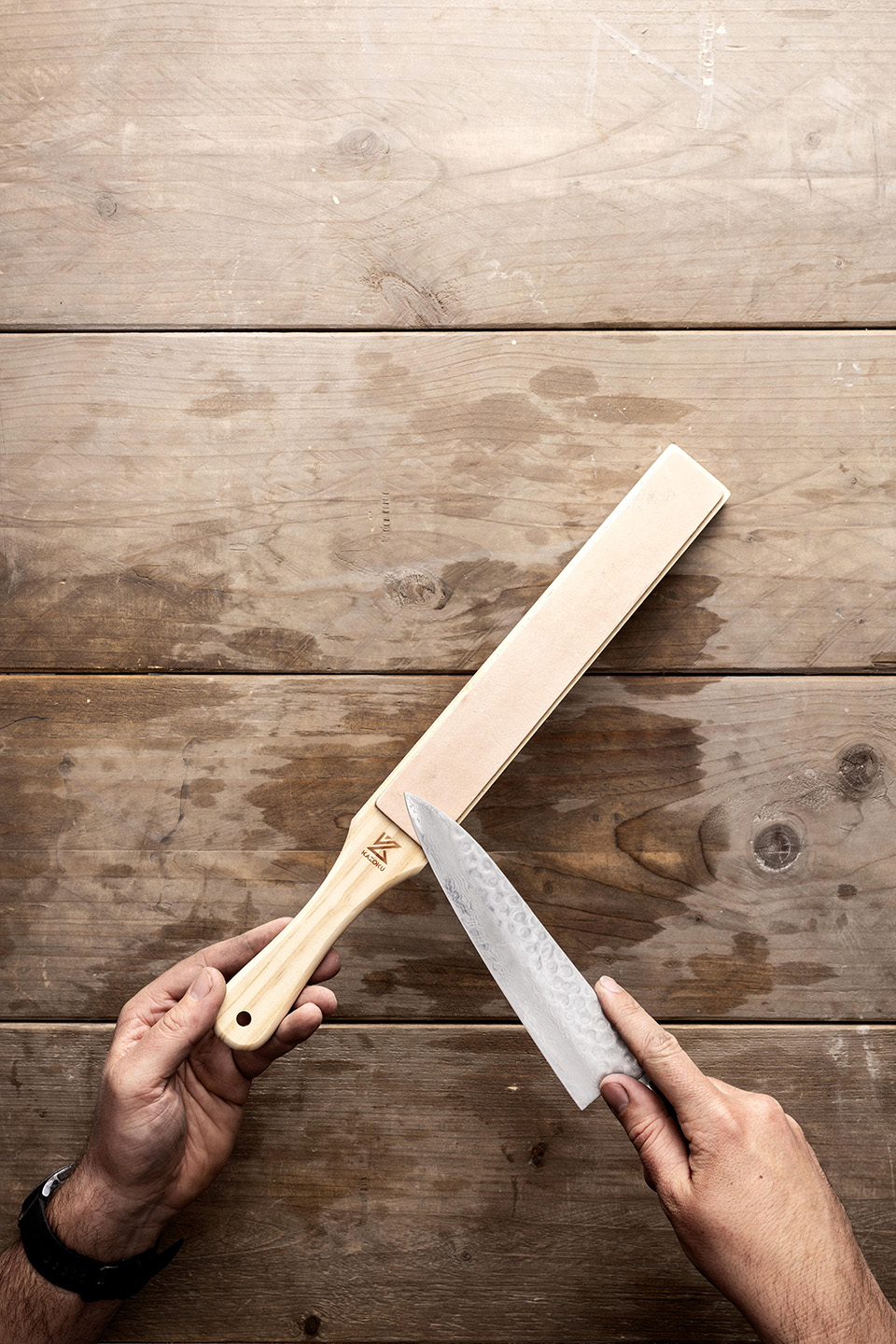
Step 7 After step 5 or 6, you should always ‘strop’. Do this with a ‘strop’ or a ‘leather’. A sort of honing steel but made of coarse or fine leather. The coarse side removes the burr (after step 5), the fine leather is used after polishing in step 6.
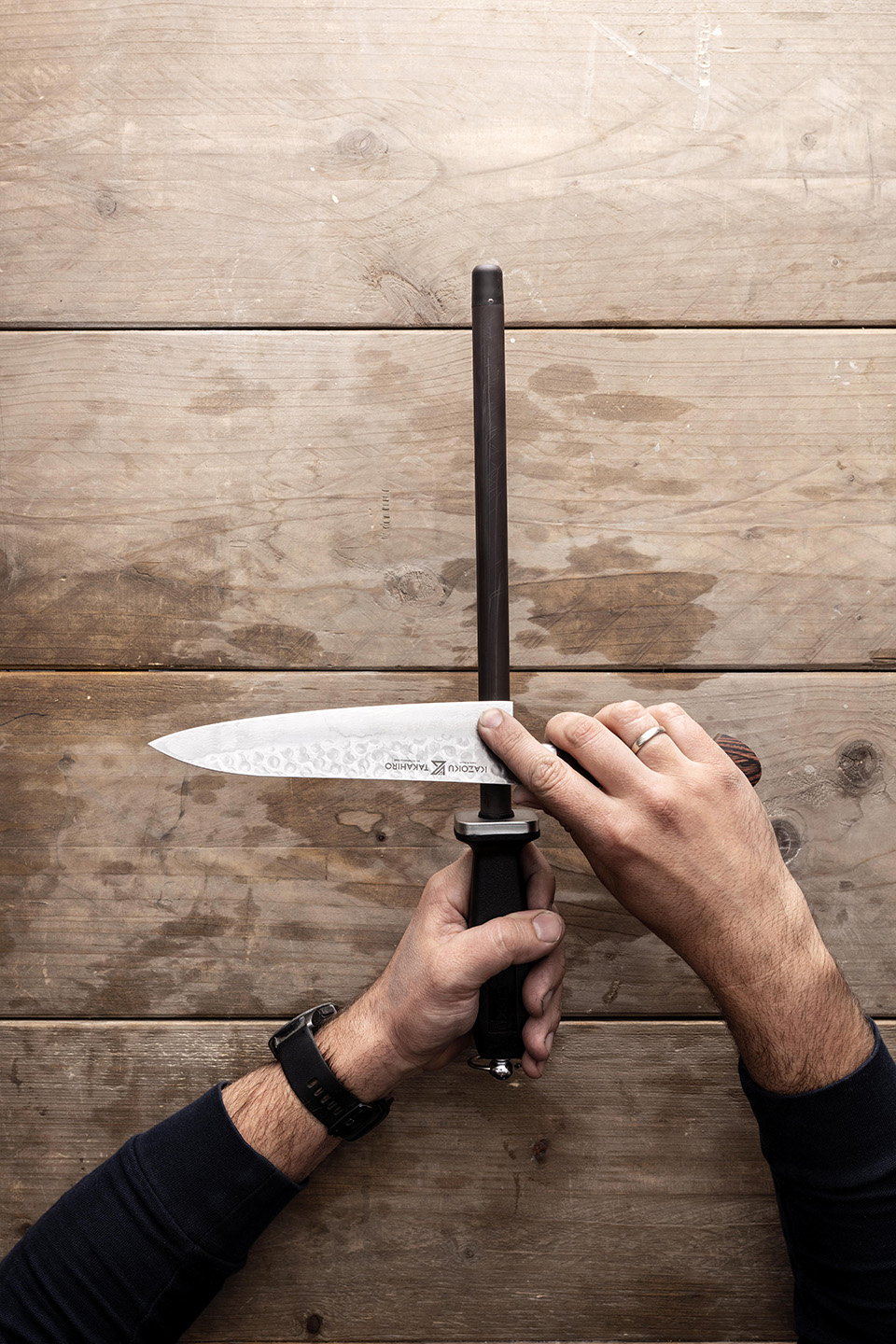
Before use. Honing once per side is really sufficient. Moving up and down 30 times makes absolutely no difference. Again, always maintain the same angle. Start at the top on the wide part of the blade and finish at the tip.

Master your knife skills with this article — then slice, dice, and carve your way to the perfect grilled entrecôte with sweet potato fries and horseradish cream sauce!
Try the recipe